The Whiskey of our Discontent by Quraysh Ali Lansana
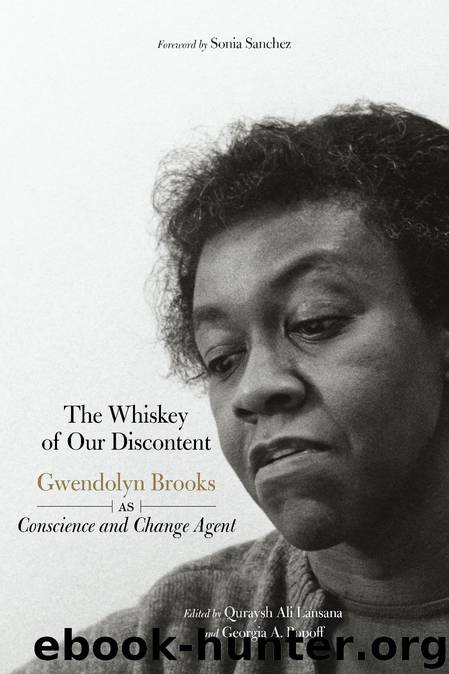
Author:Quraysh Ali Lansana
Language: eng
Format: epub
Tags: Literary Criticism
Publisher: Haymarket Books
Published: 2017-10-03T04:00:00+00:00
The Eros in Democracy
“An Aspect of Love, Alive in Ice and Fire”
Meghan O’Rourke
Why does a book-length poem called Riot (1969), which details the civic unrest in 1968 Chicago after Martin Luther King Jr.’s assassination, conclude with not a bang, as it were, but an intimate domestic scene between two lovers? What accounts for this private, interior, semi-erotic tableaux? Encountering it in an anthology, you might think this poem reads almost like a traditional love lyric. Most political poetry does not—imagine, say, Shelley’s “The Masque of Anarchy” —end with a bedroom scene. It’s much easier to imagine a version of Riot that concludes with a hortatory, impersonal from-on-high vision of renewal, something like Auden’s “we must love one another / or die” or Audre Lorde’s “The difference between poetry and rhetoric / is being ready to kill / yourself / instead of your children.” In fact, when Riot was anthologized in the Library of America’s The Essential Gwendolyn Brooks, this third section was left out, presumably because the editors considered it less important than the first two sections, which are, on a superficial read, more overtly “political.” But what I want to argue here is that in some sense the real politics of this poem lie with its ending—that you cannot omit the ending without neutering or, in some sense, whitewashing Brooks’s vision. In some ways, this poem is more political and original because of this tiny lyric.
The third part of Riot is the shortest of the three sections, taking up little more than a page. It comprises seven stanzas, several of which are one line long. It reads, in full:
It is the morning of our love.
In a package of minutes there is this We.
How beautiful.
Merry foreigners in our morning,
we laugh, we touch each other,
are responsible props and posts.
A physical light is in the room.
Because the world is at the window
we cannot wonder very long.
You rise. Although
genial, you are in yourself again.
I observe
Your direct and respectable stride.
You are direct and self-accepting as a lion
In African velvet. You are level, lean,
remote.
There is a moment in Camaraderie
When interruption is not to be understood.
This is the shining joy;
The time of not-to-end.
On the street we smile.
We go
In different directions
Down the imperturbable street.2
Because this section is quite different from the first two sections of the poem, which are polyvocal, fragmentary, and overtly sociopolitical in nature, to read Riot is to have to ask why it ends with an invocation of individual and—crucially—erotic renewal.
There are two interconnected answers. For one thing, Brooks wanted, I think, to push back against the popular (white) vision of an undifferentiated mass of rioters. (See, for example, the lines in the poem’s first section when the rioters are seen by the white John Cabot: “[T]he ‘Negroes’ were coming down the street. / . . . they were coming toward him in rough ranks. . . . / They were black and loud. / And not detainable.”3) It is implied that the lovers are Black, and it would seem, then, that she
Download
This site does not store any files on its server. We only index and link to content provided by other sites. Please contact the content providers to delete copyright contents if any and email us, we'll remove relevant links or contents immediately.
4 3 2 1: A Novel by Paul Auster(12391)
The handmaid's tale by Margaret Atwood(7763)
Giovanni's Room by James Baldwin(7346)
Asking the Right Questions: A Guide to Critical Thinking by M. Neil Browne & Stuart M. Keeley(5775)
Big Magic: Creative Living Beyond Fear by Elizabeth Gilbert(5771)
Ego Is the Enemy by Ryan Holiday(5447)
The Body: A Guide for Occupants by Bill Bryson(5096)
On Writing A Memoir of the Craft by Stephen King(4943)
Ken Follett - World without end by Ken Follett(4731)
Adulting by Kelly Williams Brown(4574)
Bluets by Maggie Nelson(4556)
Eat That Frog! by Brian Tracy(4537)
Guilty Pleasures by Laurell K Hamilton(4448)
The Poetry of Pablo Neruda by Pablo Neruda(4106)
Alive: The Story of the Andes Survivors by Piers Paul Read(4031)
White Noise - A Novel by Don DeLillo(4009)
Fingerprints of the Gods by Graham Hancock(4004)
The Book of Joy by Dalai Lama(3986)
The Bookshop by Penelope Fitzgerald(3852)
